Circular Design, Engineered In: The Next Generation of Enterprise Workspaces
Why future-ready offices will keep materials in the loop, and what that means for cost, compliance and long-term value.

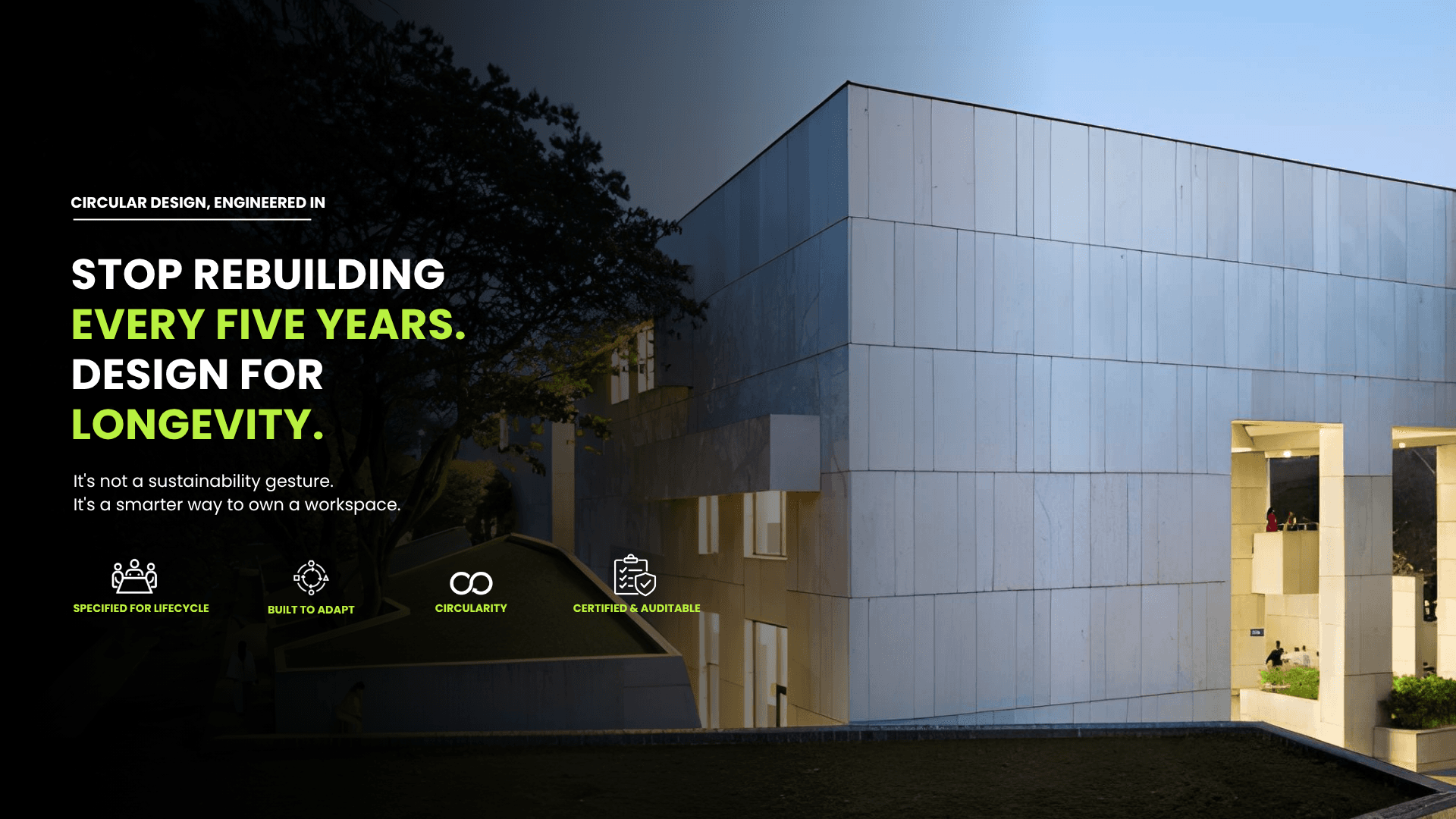
Introduction: The Hidden Liability in Every Fitout
The typical corporate interior is stripped out and rebuilt every five to seven years, and most of what comes off the walls and floors goes to landfill. For an enterprise managing millions of square feet across multiple locations, that is recurring capital expenditure, growing ESG exposure and avoidable waste, cycle after cycle. It is a liability that never appears as one, because each individual fit-out looks like a fresh start.
What Circular Design Really Means
Circular design breaks that cycle. It minimises waste, extracts the full value of every material and keeps resources in continuous use, instead of moving them in a straight line from factory to fit-out to disposal. Done well, it changes the economics of a workspace and not only its carbon number.
It Starts at the Design Table, Not the Handover
Circularity is a discipline rather than a style, and like any discipline it starts early. Sustainability retrofitted at the end of a project earns a certificate. Engineered in from day one, it produces measurable outcomes. That means materials chosen for their whole lifecycle, elements designed to be moved and reused, and a build detailed so it can be taken apart as intelligently as it went together.
Material Intelligence Over Material Habit
Most specification decisions get made on habit and unit cost. Circular design asks a harder question: what is the full lifecycle impact of this material, and what happens to it when the space changes? The principles are easy to state and demanding to execute, which is to prioritise renewable and recycled inputs, reuse and refurbish before buying new, and weigh total lifecycle impact rather than the price at procurement.
Certifications Turn Claims Into Evidence
Certification is what makes that rigour credible to someone outside the project. Anchoring specifications to recognised standards moves sustainability from claim to evidence: FSC for responsibly sourced wood, Cradle to Cradle for recyclability, GreenGuard for low-emission materials. These function as audit trails, and they hold up in front of an ESG committee in a way a marketing badge does not.
Manufacturing as a Sustainability Advantage
Control over materials is where a manufacturing capability starts paying sustainability dividends. Ensemble's 1,25,000 sq. ft. in-house facility gives direct oversight of what goes into a build, the option to refurbish and repurpose existing furniture instead of replacing it, and the precision to make components designed for future disassembly.
Design for Adaptability
The most sustainable interior is the one that never needs demolishing. Designing for adaptability means modular, moveable, easy-to-disassemble space: a meeting room that reconfigures, furniture systems that relocate with the team, partitions that come apart without destruction. For CRE and workplace leaders, that reads as a lower total cost of ownership across the life of the asset rather than a one-time saving at fit-out.
Reduce Waste at the Source
Waste is rarely a single event at demolition. It accumulates through short-term choices made years earlier, which is why a durable specification means less disposal later. BIM-led planning tightens this at every stage: accurate quantification reduces over-ordering, off-site manufacturing controls offcuts, and precise coordination cuts the rework that generates most site waste.
Why It Matters to the Enterprise
For the Fortune 500 and Fortune 1000 businesses Ensemble builds for, circular design earns its place commercially before it earns it as a value. Certified materials give measurable ESG progress, lower total cost of ownership arrives without trading quality for savings, and spaces adapt instead of being demolished. Across 23+ years and 1,900+ projects, engineering sustainability in from day one is what lets a workspace perform today and stay responsible tomorrow.
Conclusion
Circular design is a smarter way to own a workspace. Keeping materials in the loop, designing for adaptability and engineering waste out at the source turns a recurring liability into long-term value, with the certification trail to prove it.