India's GCC Shift From Capacity to Capability Demands a New Workplace Brief
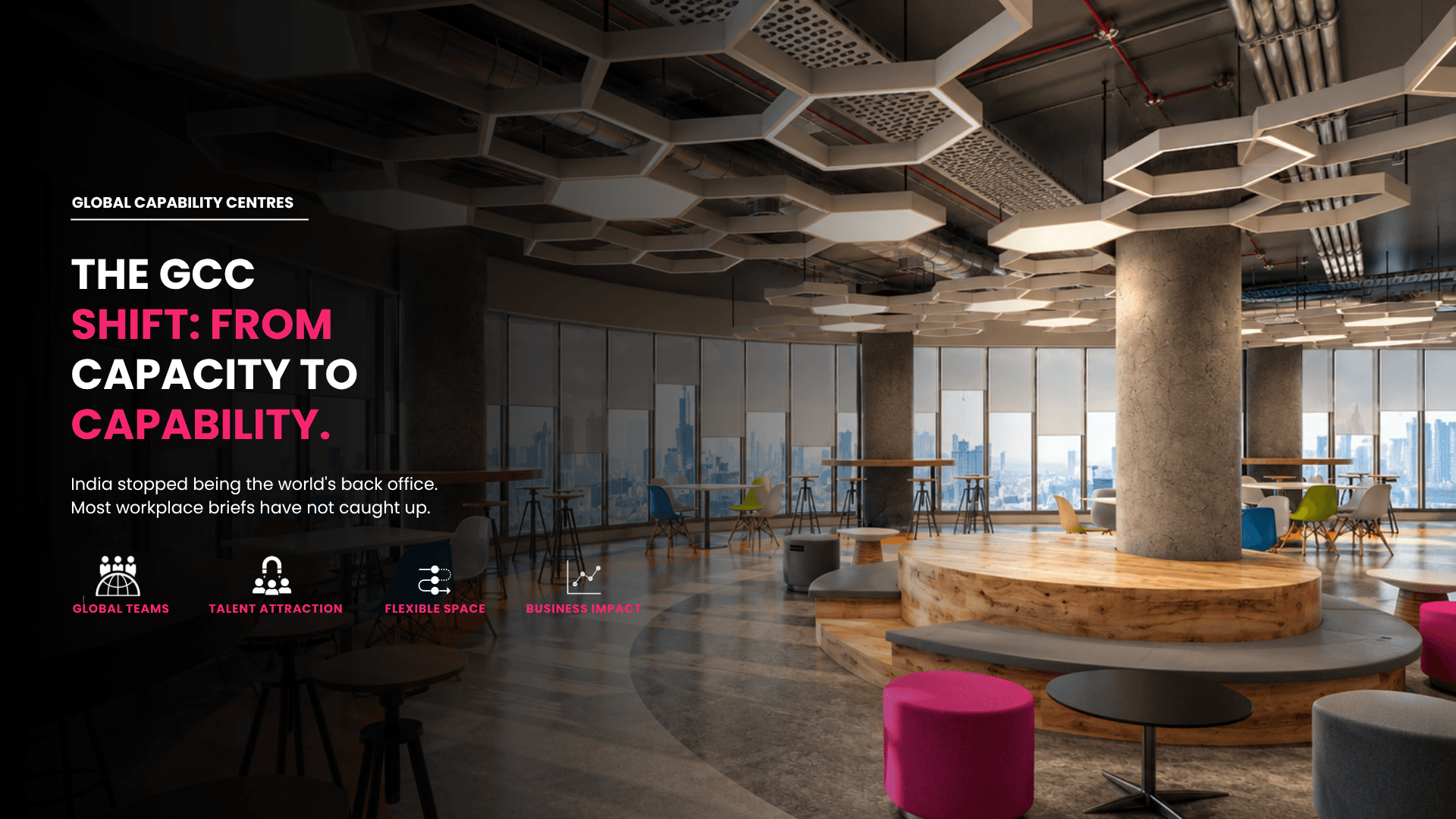
India stopped being the world's back office years ago. Most workplace briefs have not caught up.

Narrative That Changed
For years, India was known as the world's back office, valued for scale and cost efficiency. That has changed. Nearly half of India's office leasing in H1 2026 came from Bengaluru and Hyderabad alone, which shows where global enterprises are building the capabilities they care about most. The work being done in those centres has changed along with the scale. India is now where organisations develop AI, engineer products and lead digital transformation. The output is intellectual rather than transactional. Yet many centres still sit in buildings designed for the previous model, with floor plans that were optimised for a different kind of work and a different relationship between the employee and the office. The mismatch is easy to miss because the buildings still function.
Two Different Briefs
A back office is designed for efficiency: low cost per seat, standardised fit-outs and maximum density. That suited high-volume, process-driven work, where the main goal was to house as many people as possible at a sustainable cost. Success was measured in seats delivered and cost per seat, and by those measures many of these buildings performed well. A Global Capability Centre has a harder job. It has to attract talent, foster cross-disciplinary collaboration, accelerate innovation and carry a culture that most global leaders will never visit in person. Applying the old brief to this new purpose produces a building that works against its occupant. Nothing about it looks wrong on a plan, which is why the problem often goes unnoticed until people start staying away.
Why Density Stopped Working
Engineering, design and research depend on deep concentration punctuated by high-bandwidth collaboration. A dense open floor delivers neither. It is too noisy for focus and too crowded for a team to gather around a problem and work through it together. Teams end up with neither the quiet they need for individual work nor the space they need for group work. People adapt by working around the building. They work from home when they need to think and come in only to talk. The organisation then pays for a building that supports the easier half of the work, while the harder half happens elsewhere. That cost never appears in a facilities report, because the building still looks busy on the days people do come in. The organisation sees full floors and assumes the building is working.
Ask a Better Question
Many workplace conversations still begin with how many people can fit. That question converts neatly into cost, which is why it remains popular, and it predetermines the outcome. Ask it first and the answer will almost always be a dense floor. Density may still be part of the answer, but it should come out of the brief rather than set it. The better question is which capabilities the workplace should enable. It shapes planning, technology, collaboration infrastructure and flexibility. It also gives every design element a rationale that survives value engineering, because each element can be traced back to a capability the business has said it needs. When budgets come under pressure, that traceability makes it clear what would be lost by cutting each item.
Talent Is the Real Constraint
GCCs compete for high-skill talent with global tech firms, startups and each other, often in the same micro-markets. A candidate weighing two offers walks through both buildings, and each one communicates how the organisation treats its people. The workplace becomes part of the offer whether anyone plans for it or not. Candidates compare light, acoustics, amenities and the general feel of the floor, and they draw conclusions from all of it. Those impressions can tip a close decision. The retention arithmetic is simple. Replacing an experienced engineer is expensive. A modest retention gain across a few hundred technical staff can justify the workplace investment on its own, before any of the other benefits are counted. Few other line items in a GCC budget can make that case so directly.
Collaboration, Focus and Hybrid
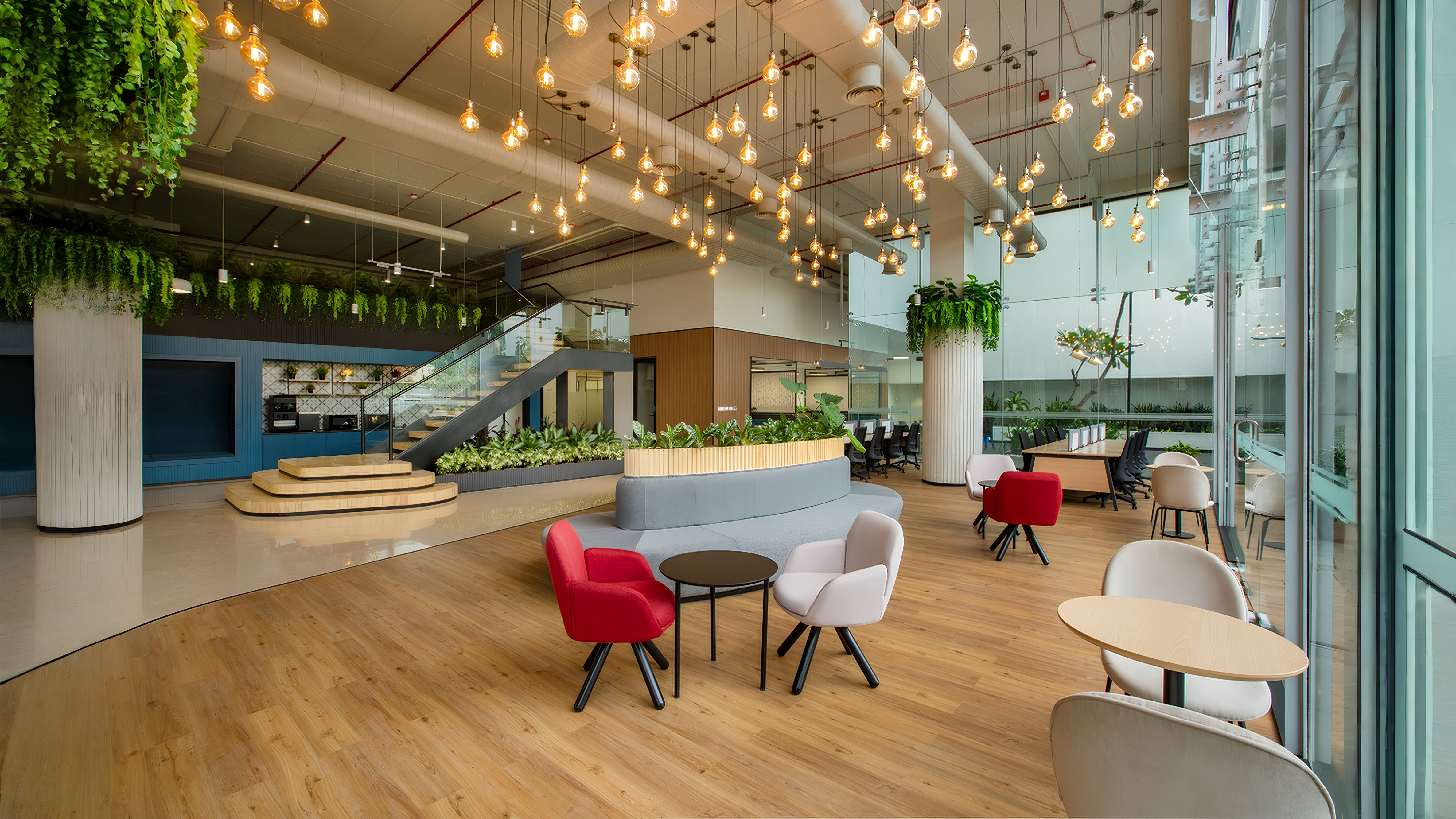
Collaboration in a capability centre is continuous, so it needs more than extra meeting rooms. It needs writable surfaces, unbookable ideation zones, sprint-length project rooms and team neighbourhoods. Focus is the underserved requirement. Acoustic zoning, focus rooms, quiet libraries and phone booths make deep work possible on site, so people no longer have to go home to concentrate. Because GCCs work across time zones, every room is a hybrid room. Camera placement, acoustics and lighting decide whether global colleagues can contribute to a discussion or only watch it. A room that works for the people sitting in it and fails for the people dialling in is only doing half its job. Getting this right takes AV, acoustic and lighting design working together from the start.
Flexibility and Delivery at Scale
A GCC's mandate changes faster than its lease. Modular infrastructure, movable partitions and adaptable MEP let it absorb change without a full refit. New teams and reorganisations can be absorbed with far less disruption to the people already working there. Delivering custom joinery consistently across 100,000 sq. ft. or more is hard. Ensemble's 1,25,000 sq. ft. in-house manufacturing facility controls lead times and quality, and BIM-led planning resolves coordination before mobilisation, which makes enterprise programmes predictable. For a GCC growing quickly, predictable delivery matters as much as the design itself. Late fit-outs delay the teams waiting to move in.
Conclusion
The real shift in India's GCC sector is from capacity-driven workplaces to capability-driven enterprises, and the brief is where that shift either happens or stalls. Across 23+ years, 1,900+ projects and 12M+ sq. ft. delivered for Fortune 500 and Fortune 1000 organisations, Ensemble treats workplaces as business infrastructure. In the GCC era, the measure of a workplace is how much impact it helps people create, rather than how many people it can fit.