Culture Shapes Employee Experience, but the Workplace Is Where It Shows
HR and workplace strategy run as separate conversations. Employees experience them as one.

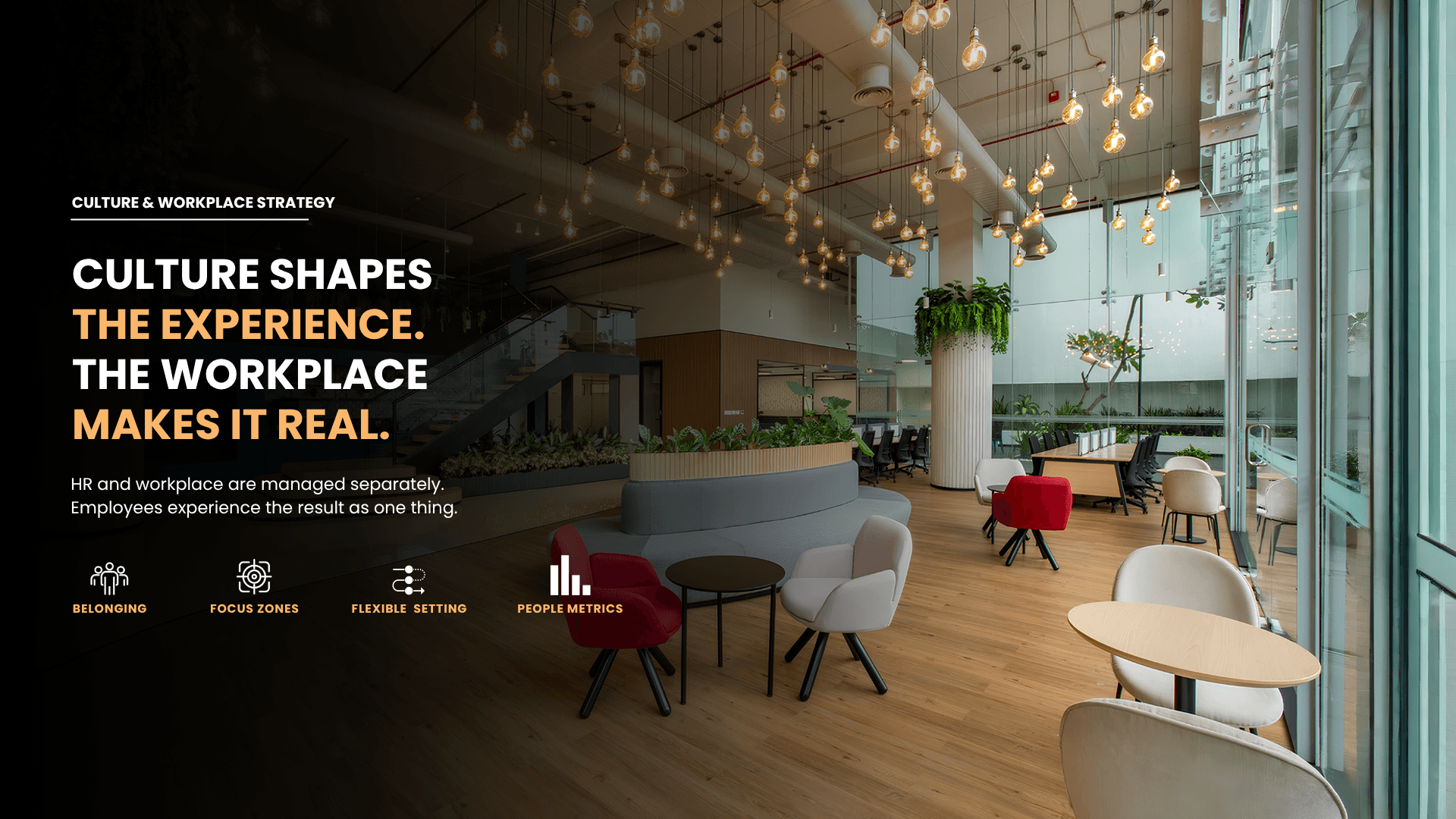
Two Conversations, One Experience
In most organisations, culture and workplace are owned, budgeted and measured separately. CHROs talk about values, belonging and engagement. Workplace leaders talk about utilisation, acoustics and cost per seat. Both conversations are serious, and both are led by capable people. They just rarely happen in the same room. Each side reports to different leaders and is judged on different numbers, so neither has much reason to join the other's discussion. Employees experience none of it in isolation. Every day, they reconcile what they are told the company values with what the environment lets them do. When the two contradict each other, people believe the building. A values framework is an assertion. A floor plan is evidence, and people check that evidence every time they look for a meeting room or a quiet place to think.
Where the Contradiction Shows
Consider an organisation that champions collaboration while its meeting rooms are booked a week out and the only informal space is a corridor. That is a supply problem rather than a behaviour problem. People want to collaborate and have nowhere to do it, so they stop trying or move the conversation online. Telling them to collaborate more will not help while the rooms they need do not exist. Another organisation promotes focus and wellbeing on an open floor with no acoustic zoning and nowhere to take a call. Staff notice the gap quickly. Over time, people stop reading internal communication as information and start reading it as something the organisation says. Once that happens, every new initiative starts with a credibility deficit that no campaign can fix.
What Space Can and Cannot Do
Space does not determine culture. A beautiful office with poor leadership produces disengaged people in a nicer room. But space is good at four things. It signals priority through what gets floor area. It shapes encounters through adjacency and circulation. It enables choice through varied settings. And it lowers friction. The first three get most of the attention in design reviews. Friction is the hidden variable. There is no room for a call. The audio with remote colleagues is poor. There is a queue for the only booth. Each of these costs a few minutes and a little goodwill, repeated hundreds of times a year. Almost all of it is designable, which means almost all of it can be designed out before anyone moves in. Removing it rarely needs a bigger budget, only earlier attention to how people actually spend their day.
Design for Behaviour, Not Headcount
Most briefs begin with a headcount and a budget per seat. That produces a plan optimised for accommodation, where success means everyone has a desk. A culture-led brief starts somewhere else. It asks which behaviours the organisation depends on, which of those are currently difficult, and what would make them easy. Headcount still matters, but it becomes one input among several instead of the starting point. The answers change the building. A team that needs deep technical focus needs acoustic infrastructure. A team that needs faster cross-team decisions needs adjacency and informal settings where people run into each other. With the same headcount and the same budget, those two briefs produce two different buildings. Which one you get depends on which question came first.
Bring HR In at Concept
HR holds the data that should drive the brief: engagement patterns, attrition reasons, team structures, flexibility policy and real attendance. Workplace and CRE teams hold the constraints and the delivery mechanism. Each side has half the picture, and a good brief needs both halves from the first workshop. Working together, they produce a brief where each spatial decision traces back to an organisational objective. That makes the brief defensible in front of finance, because every square foot has a reason attached. Left separate, HR ends up commenting on finishes after the layout is fixed, and when the space underperforms, nobody can explain why. The data that could have explained it was sitting with HR the whole time.
Change Management and Hybrid
A floor designed for activity-based working turns back into assigned desks if nobody explains the intent. Quiet zones stay quiet only when leadership observes them too. Communication and modelling belong in the project plan from the start, with time and budget of their own, rather than as an afterthought in the week after handover. People need to understand why the floor works the way it does before they will change long-standing habits. Hybrid working made this unavoidable. People now decide every week whether the commute is worth it, and they judge the office by what it offers that home does not. A desk and a screen are available at home. Colleagues, mentoring and a sense of belonging are harder to find there. Culture has become the office's competitive advantage. An office that offers nothing home cannot will see attendance fall, whatever the policy says.
Measure the Right Things
Utilisation shows how much space is used. It does not show whether the space works. Better measures sit alongside it. Do people find the right setting when they need one? Does cross-team interaction rise after the move? Do new joiners integrate faster? Do exit reasons mention the environment? These are harder to collect than badge data, but they answer the question the investment was meant to answer. They also give HR and workplace teams a shared set of results to discuss.
Conclusion
Culture and workplace are two halves of one employee experience. At Ensemble, across 23+ years and 1,900+ projects, the work that succeeds has started from behavioural objectives instead of a seat count. Design around the behaviours the culture depends on, bring HR into the brief early, and measure whether the space enables what it was built for. The strongest workplaces make culture tangible in the places where people spend their working day.